
Reflection and Self-Improvement

Recently, during a group product discussion, several folks asked me to elaborate on how I approach retrospectives and reflection. What they didn't expect was that part of what has led to a pretty successful career is less about my professional nature than about how I approach reflection and self-improvement in general.
No matter the walk of life, if I have taken an interest in something, I want to understand it and get better at it. In fact, it will bother me greatly until I can at least reach a plateau in my understanding and ability. I also don't sit still well, and have this weird desire to live a healthy, happy life.
What follows is a summary of what I shared in that group discussion regarding the various ways I try to improve, peppering in techniques from Agile, Stoicism, Cognitive Behaviour Therapy (CBT), and more. I hope it helps you!
Principles
If I had to boil things down to overarching principles that either curate or feed this practice, they would be:
- Building Emotional Intelligence: Cultivating awareness and management of emotions for healthier responses.
- Philosophical Reflection: Using timeless wisdom to align actions with purpose and virtues.
- Retrospectives & Goal Setting: Regularly reviewing progress to set and refine meaningful objectives.
- Habit Building & Tracking: Systematically forming and monitoring behaviours for lasting change.
- Productive Feedback Loops: Gathering and synthesizing input to drive continuous improvement.
Cadences
There are big and small ways to tackle these areas, and I like to categorize them by the cadence at which I typically act on them.
- Yearly: Goals & broad vision.
- Monthly: Habits retrospectives.
- Weekly: Habit adjustments, feedback.
- Daily: Habit tracking, emotional assessments.
- Initiative/Quarterly/Seasonal: Retrospectives, goal setting.
Breaking it down
Yearly
- At the end of the year and at its start, I reflect.
- Generally, my partner and I ask each other questions about the past year and the year ahead. What our wants, hopes, and goals are. Who and where we want to be.
- I often have larger goals written down somewhere, which I will compare with new desires.
- Am I being too ambitious/not ambitious enough?
- How much has what I'm chasing changed over the year?
- What did I attempt and fail or fall short at?
- Overall, did my habits help or hinder my goals the past year? What needs to change?
- Repeat goals I've had each year include:
- How many books I'll read.
- How many personal projects I'll complete.
- What physical activity will look like and evolve into.
Monthly
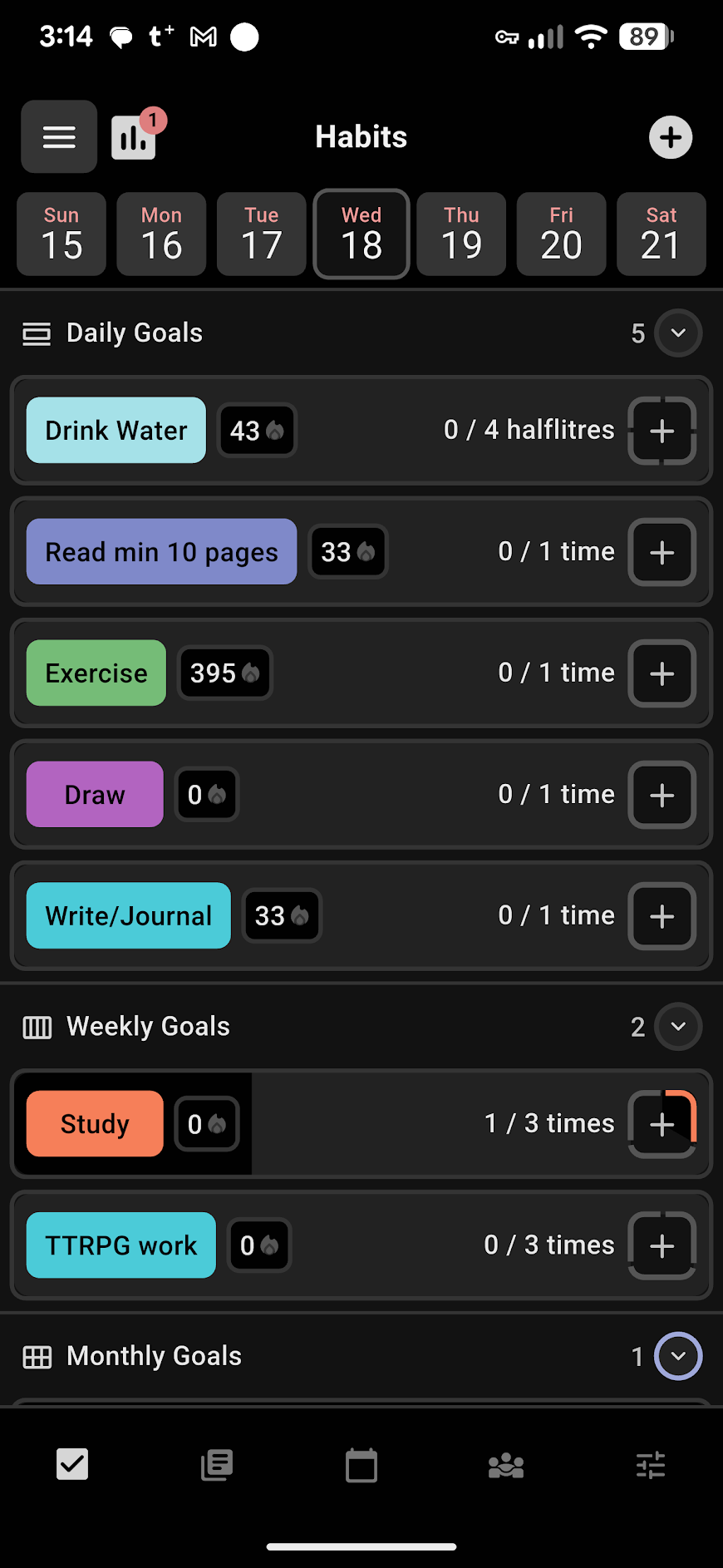
- I use a micro-habit app called HelloHabit to track the many behaviours and actions I am trying to turn into regular habits, or to keep existing ones.
- Every month, HelloHabit sends me a report of how I've done. I use this similar to Atomic Habits (But I did this before I knew what Atomic Habits were, so take that James Clear!)
- I'll set smaller goals, adjust habits (raising or lowering their desired frequency, amounts, and more).
- I'll set reminders in my calendar for important events or check-in points.
- I ask the people I work with closely for feedback monthly, rotating who I ask.
- Intentionally synthesizing it.
- Sorting it.
- Weighing it.
- Looking at it through different lenses of my goals or principles.
- Relatedly, I teach those I work with to be more intentional in their retrospectives on projects and within Agile cycles.
- A good retro must:
- Ask meaningful questions, not just fluff.
- Uncover iterative actions for the team to improve.
- Assign those actions to people.
- Hold people accountable for what they said they would do last time.
- A good retro must:
Weekly
- At the end of the week, I look back at my journal, check how my habit "streaks" are going, and decide what I need to do differently. Rather than waiting until next week, I get started this weekend.
- For example, if I haven't been physically active enough, I will propose to my wife that we go to a park for a longer walk.
- As soon as I realize something, I try to prioritize it and act on it as best I can.
- Every Sunday, I look at my calendar for the week ahead.
- Is anything missing? What do I need to capture or remind myself of?
- For anything there, is there anything I should do to prepare myself?
- What will help me be more successful and help those around me?
Below is a screenshot from my HelloHabit app showing some of the daily and weekly goals I have set. I've recently made drawing a daily habit as I try to improve again, so you see that it has a "0" streak, whereas my wife and I have managed to do something active every single day for over a year now, so there's a great streak amount next to Exercise.
Daily
- Being cognizant, daily, of emotion, practicing mindfulness whenever possible.
- Partially through studying CBT and partially just because that’s how my brain works.
- Intense emotions are noted and prompt reflection, and may lead to subsequent changes in patterns.
- Studying stoicism and attempting to apply it, daily. E.g. current ponderings:
- Am I going toward or against my purpose? Am I living in harmony with [my] nature?
- Am I valuing the right things? Am I showing/chasing temperance, courage, justice, and wisdom in all things?
- Do I understand what’s in my control vs external and out of my control? What personal thoughts, opinions, decisions and duties [the things I can control] are relevant right now?
- What is currently toxic and dragging me down? What joy could I bring to my life and those around me? How can I bring more rational thought, gratitude and care to the current situations and others?
- In particular, I attempt to identify whenever I am investing in hope, fear, or anger, as none of them pays off. I allow myself to feel these things, but try not to dwell on them.
- Try not to blame, and instead focus on what I am responsible for and can change myself.
- Try not to isolate, and to recognize we are all connected. Treat others the way they would like to be treated, and put into the world what you’d like to receive back.
- Practice gratitude, encourage collaboration over competition, do no harm, and build and show empathy.
- At the end of every day, I Bullet Journal, and at a minimum, capture the notable headline of the day and what I'm grateful for. Over time, this has greatly helped me recognize what I value day-to-day, what I should shrug off, and what I should avoid.
- When I have more energy, I dive into my notable headline of the day, writing more, dissecting it, and exploring related topics, often turning it into a form of free-writing.
Initiative/Quarterly/Seasonal
Many habits or goals are either tied to the current season or ignore it. For example, where we live, it gets very cold and slippery. My "Exercise" habit was initially framed more as "Go for a 30-minute minimum walk every day." While that seemed great, after several of our family members and friends fell and broke bones, and I fell myself unscathed, I took it as a signal–It can't always be about being outside–so I adjusted the goal to be less specific. I still go for a walk most days, but admittedly not when it's colder than -10 Celsius or extremely icy.
In this respect, every 3 or so months, I try to assess how I've been approaching my days and weeks with respect to the world at large. How are external factors influencing me, and what do I need to change? This is similar to how I approach teaching a lot of teams I work with as well. We'll start with a SWOT exercise to familiarize them with the company's or product's strengths, weaknesses, opportunities, and threats, then, in a quarter, revisit and see how we're doing. Is there anything we should adjust? Anything we misjudged?
Recommended tools and reading
- HelloHabit - Habit tracking app, syncs across devices, a lot of configurability.
- Atomic Habits by James Clear - Dives into similar concepts of building healthy habits, starting small, and not overthinking things.
- Stoicism - Ancient Greek/Roman philosophy based in reason, rational discourse, monistic physics, and naturalistic ethics.
- Meditations by Marcus Aurelius - Famous stoic and emperor of Rome's journal, filled with proverb like quotes to help you contemplate stoic virtues of wisdom, justice, discipline and courage.
- Bullet Journalling - A framework for simple journalling.
- Cognitive Behaviour Therapy (CBT) and Thinking Traps - A tool that should be in anyone's toolbox to help navigate intense emotions, stigma, and bias.


