
Small isn't lean and large isn't bureaucratic.

"Lean" and "small" are different things, yet most people use the words interchangeably. If you aren't familiar with it, "Lean," as a framework and philosophy for business, was invented at Toyota, a company with hundreds of thousands of employees. It's not a synonym for "scrappy," although a lot of tech bros seem to think otherwise. Eric Ries borrowed the name for The Lean Startup, which became a very popular book, and a generation of founders absorbed "lean = small/fast/MVP" without ever encountering the actual Toyota Production System that informed it.
"Bureaucratic" and "large" are also different things. Max Weber's original meaning of bureaucracy was a "modernist achievement": rules, roles, expertise, and written procedures replacing patronage and whim. At the time, it made sense. What people mean when they sneer at "bureaucratic" is a dysfunctional bureaucracy: like ritual without purpose, and process as the goal rather than the means. If you're following along with me, Lean and Dysfunctional Bureaucracy deal with quality problems, not size problems. In other words, what actually scales (or fails to) is the mindset, not an organization's org chart. Fundamentals of Lean, like Kaizen, going to see, respect for people, building quality in, these things work at 5 people and 50,000 people organizations. What changes are the artifacts (a hallway conversation vs. a standardized system), not the principles.
The number of times in my career I've heard "we want to stay lean" when what they actually meant was "stay small" or "avoid rules" is wild. Then they hire 100 people, because growth-at-all-costs demanded it.
Things break. Quality drops. Engagement craters. And they wonder where they went wrong.
They never understood how to operate effectively. They just had a word that let them pretend they did.
The cost
The cost of this confusion isn't linguistic. It's that an enormous number of teams operate under names that don't match their reality. They believe they're lean when they're actually fast and lucky. They believe they're doomed to bureaucracy because they got big, when what they're actually experiencing is a series of fixable choices. The label is doing the team's self-awareness for them. Badly.
A brief, unromantic history of Lean
- Lean originated at Toyota during a post-war scale-up phase (for the country and the company).
- Just-in-time (JIT) is a Lean manufacturing strategy that produces and delivers items exactly when needed, in the exact quantity required, to minimize waste, inventory, and costs.
- Jidoka is a core "lean manufacturing" pillar, often called "automation with a human touch," which means stopping a production process immediately when an abnormality or defect is detected.
- Kaizen (one of my favourite concepts) is a Japanese term simply meaning "continuous improvement" and is a core pillar of Lean methodology focused on making small, incremental, and daily improvements to processes to eliminate waste and increase efficiency.
- Genchi genbutsu, another important principle of the Toyota Production System (TPS), simply means "go to the source" to observe facts firsthand rather than relying on reports from others. No telephone game, rumours, hearsay.
- Respect for People, also a core pillar of Lean philosophy, centers on engaging, developing, and empowering employees rather than just managing them.
When I teach product folks about these basics of Lean, some of the newer folks are surprised. What they think is "Lean" is actually the "Lean Startup" book, or some founder's bastardization of it, which took the language from the Lean methodology and philosophy but didn't capture the depth.
A note on the book that ate the word
The Lean Startup from 2011 isn't bad, but it's clearly lacking in the conversations I've had with founders and stakeholders who got their understanding of Lean from that book. TPS is credited explicitly throughout. Small batch sizes, the Five Whys, Kaizen, eliminating waste, they're all there. Some great stuff.
Ries also genuinely extended Lean into new territory: discovery under uncertainty. Toyota knows what it's making, and the work is making it efficiently; a startup doesn't know what it's making, and the work is finding out. That's a real intellectual contribution, and it's why Lean Startup deserved a name of its own. The problem isn't the book. The problem is that its name became the word that ate "Lean" for an entire generation of founders.
So, what got lost or thinned in translation?
- Just-in-Time doesn't really translate. JIT is about steady-state production with known demand. Startups often have neither. Minimum Viable Products (MVPs) are sometimes pitched as the JIT analog, but the analogy is loose and a lot of founders and practitioners alike have varying definitions of what an MVP is.
- Jidoka mostly disappears. "Pivot-or-persevere" has a flavour of "stop the line when something's wrong," but it's about strategic direction, not built-in quality. If I had to guess, I think this could be one of the many originators of our current-day struggles with enshittification. Founders pivot to value, pivot to value, and pivot to value, but quality and integrity are often distant considerations in that equation, if at all.
- Genchi genbutsu survives as a ghost. Steve Blank's "get out of the building" (from Customer Development, which Lean Startup builds on) is the real heir here, and it's the part most startups skip in practice. A lot of start-up folks mistake this for sales opportunities rather than learning anything.
- The most damning gap, "Respect for People," is largely absent. Given the culture Lean Startup got absorbed into, again, it's no wonder we're seeing disengaged workforces, mass layoffs in favour of an executive's shallow AI strategy, and enshittification. The startup world has layered Ries's framework onto a labour environment of crunch, churn, and disposable headcount. Toyota would not recognize that as Lean.
On the missing "Respect for People"
A lot of Lean writing is by ops people who get the efficiency half and treat the people half as a soft skill. That's not me. And I think the reason this pillar gets dropped isn't that people forget it, it's that they can't see it as load-bearing.
The phrase sounds like an HR poster, sure. That's the first problem. In English, respect for people lands as a vibe: be nice to your team, listen to feedback, don't be a jerk. None of that is wrong, but also none of that is what Toyota meant.
The Japanese original is closer to respect for humanity! And at Toyota, it's a load-bearing claim about how the system gets better. The mechanism is this: the people closest to the work see the problems first. If you don't trust them, train them, and give them the authority to stop the line, you don't learn. Kaizen (the principle of continuous improvement, and one of my favourite things) is impossible without it. It isn't a culture program running parallel to the production system. It's what makes the production system improve at all.
Any worker on the line at Toyota can pull a brightly coloured rope to stop production if something looks wrong. At most companies, a frontline worker stopping a multi-million-dollar line would be a firing offence. I've certainly encountered several founders who said they were pro-fast-failure and "move fast and break things," yet put a negative lens on any employees who offer constructive criticism. At Toyota, not pulling the stop rope when you should is the firing offence. This requires the understanding and belief that the people closest to the work know it best and should be enabled and empowered. That belief is respect for people in operational form. Pull the belief out, and the rope is just theatre.
When Lean was exported west, two things happened. The first is that the Toyota Production System (TPS) got rebranded as Lean Manufacturing by Western consultants in the late 80s, which made it portable but also stripped a lot of the cultural substrate. The second is that the people buying Lean were mostly founders and executives looking for cost reduction. Respect for people is hard to sell to that buyer, because it implies giving frontline workers more authority, which is the opposite of what most cost-cutting programs do. So it got demoted to a footnote, or quietly dropped.
The result? What I hinted at when I mentioned enshittification: A generation of "Lean transformations" that are really just efficiency programs in disguise. Layoffs called waste reduction. Standardization called kaizen. Surveillance called visual management. The vocabulary survived; the philosophy didn't.
Think of it like a small, messy garage vs. a large, organized warehouse. The garage feels nimble until you need to find a specific-sized bolt and wrench. The warehouse feels imposing until you realize it has aisles and labels. Size and order are independent variables. How can you organize with intention?
There are four quadrants, not a spectrum
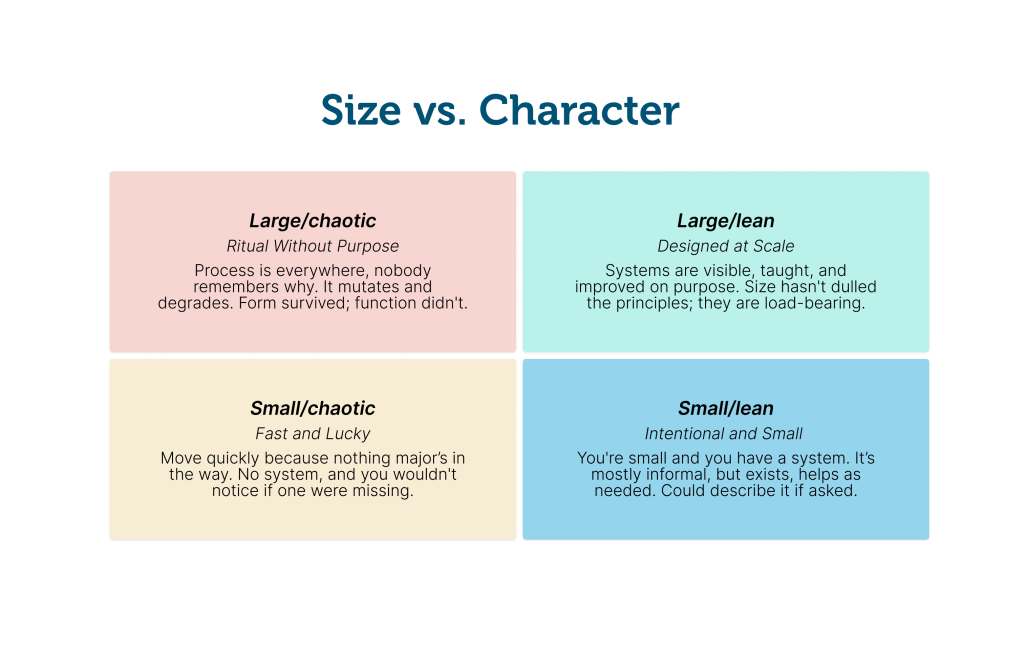
What you see here is my own Size vs Character diagram. It proposes that there are 4 quadrants and an organization may sit in one of them:
- Large/chaotic: Ritual Without Purpose. Process is everywhere, nobody remembers why. It mutates and degrades. Form survived; function didn't. This is what people mean when they say things are negatively bureaucratic.
- Large/lean: Designed at Scale. Systems are visible, taught, and improved on purpose. Size hasn't dulled the principles; they are load-bearing.
- Small/chaotic: Fast and Lucky. Move quickly because nothing major’s in the way. No system, and you wouldn't notice if one were missing. You're typically experiencing a growth-at-all-costs mentality.
- Small/lean: Intentional and Small. You're small, and you have a system. It’s mostly informal, but exists, and helps as needed. Could describe it if asked. You're growing with intention rather than at all costs.
In my experience, most teams (especially founders) think they're in the opposite diagonal of where they actually sit. Founders romanticize this phase of "we just get things done," but it's a time bomb, where chaos compounds with size, and (sorry, bro) you can't scale a vibe!
At the same time, Toyota has proven that large doesn't have to mean negatively bureaucratic. Other examples of using Lean at scale to avoid negative bureaucracy might be ASML (world supplier to the semiconductor industry), Costco, or In-N-Out Burger. What actually causes a debilitating lack of progress or innovation at size? Severed feedback loops, ritual outliving purpose, micro-management, and ownership diffused into mush. None of those are intrinsic to "bigness," they're intrinsic to neglect and hubris.
We have to avoid the trap on both sides
Small teams that treat smallness as a permanent identity (and therefore never invest in the system) and large teams that treat bureaucratic dysfunction as inevitable (and therefore never push back on ritual) are both forms of fatalism. They both kill the thing. And we don't like dead things. No, no we do not.
The actual question to ask
Organizations need to stop asking "Are we lean or getting bureaucratic?" Both are answers to the wrong question. The real question is "Are we intentional?" Intentional about how you're operating, behaving, and growing. A 5-person team can be intentional or accidental. A 5,000-person team can be intentional or accidental. That's the axis that matters.
There's a second question worth asking, and it's a harder one. It's mostly for executives: Do I want control, or do I want success? And am I willing to give up some of my control so this organization can be successful? In my experience, the people who most need to ask it are the ones who never will.
In closing
Fast and lucky is fine, for a while. It is, in fact, how most things start. The mistake is calling it lean, because that name implies a system, and a system is what you'll need when the luck runs out, and the speed becomes the problem.
Lean isn't small. Bureaucracy isn't large. Both are characters, not sizes. The character of your team is whatever you've designed it to be. Or, more often, whatever it has accidentally become while you weren't looking.
If you take one thing from this: stop using lean to mean small, and stop using bureaucratic to mean large. Vocabulary theft is the trap, and the trap keeps small teams from building real systems and large teams from believing they can still have one.
PS: Usually I try to post on Mondays, but I have a man cold, so this took many rewrites. Wish me luck... the fight continues, and I'm not sure I'll make it.


