Start small, and don't overthink it


A few years ago, I started building several small habits. I want to make things, you see, like fiction and games, but I don't have a lot of spare time. I'd heard that advice, "Just get started," so many times, but knew my real problem wasn't getting started; it was maintaining momentum in a focused direction.
I mentioned in my recap of my 2025 reads that I read Atomic Habits by James Clear as part of our work book club. To be honest, it annoyed me. In part because I was already doing what the book discussed, and in part because, given its length, it didn't offer as much practical advice to others as I had expected.
What I do
I utilize several methods to track my current goals and habits.
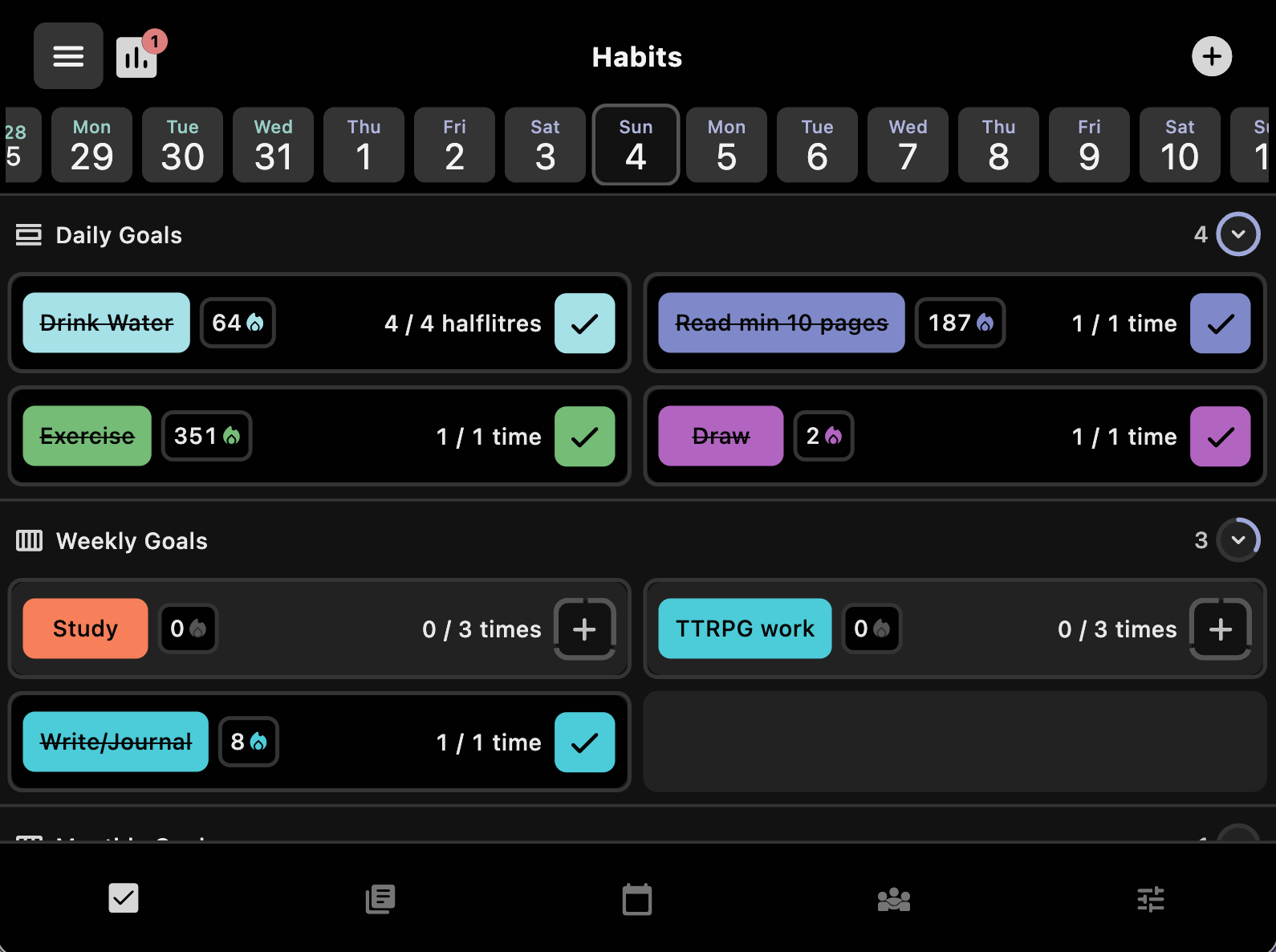
- HelloHabit, a habit-tracking app for daily, weekly, and monthly tracking.
- Alarms on my phone for daily tasks.
- Calendar events with reminders for specific appointments.
- Bullet journaling to plan, recap, and track, but also to be critical of myself, build healthy introspection, and ask myself hard questions.
- Recognize my issues with "object impermance" and make sure certain things like drawing materials and my journal are kept out, in my view, where I'd like to tackle them.
- I ask collaborators, like my wife, to join me in several habits.
E.g., my wife joins me in working out for at least 10 minutes every day to remain accountable. - Break larger projects into manageable, smaller pieces, often tracking them in spreadsheets like a typical workback schedule (WBS).
- Assess my current trajectory, quarterly, and ask if I'm doing things and surrounding myself with people who support who I want to be. If not, I try to readjust. This is often done in my journal, a spreadsheet, or a one-off document.
- Surround myself with content related to my current goals and habits.
E.g. subscribing to tons of art accounts that share their techniques to motivate me to try new things with my own drawing. - Remove distractions from my current goals and habits.
E.g. unsubscribing from shitposting, political, and other accounts that only upset me or cause me to go into a spiral of social media activity.
What I'm working on
Last month, I was laid off from my job, so a lot of my time has been going to job hunting, employment insurance, and lawyer-related tasks. I had also predicted down to the day when I would be laid off two months in advance (the joys of autistic pattern recognition), so I had been trying to prepare for it even before the fact. That being said, since I've set up so many smaller habits that are building toward long-term progress, I've still maintained decent momentum despite this major life setback.
Goals for 2026
- Land my next job by the end of February, with an organization that's a good culture match.
- Release my TTRPG, Bug & Claw, in an alpha state, by the end of June.
- Complete my first small manuscript set in the Bug & Claw world, by the end of the year
- Reduce my migraine days per month by 2-3 by the end of June.
- Help my cat, Madonna, healthily lose 1-2 lbs this year.
Example of how I support goals with habits, or smaller milestones
Let's use the TTRPG work as the first example.
For the last couple of years, I have been working on some larger tabletop roleplaying game (TTRPG) projects, and writing fiction. Namely, Bug & Claw, a game and fictional world based on intelligent anthropomorphic arthropods living on a post-apocalyptic Earth. To further this work, I've started weekly habits, looped in collaborators, and more.
- Created a WBS to help break things down into smaller chunks of work.
- Invited collaborators to surround myself with motivation, maintain momentum, and be accountable.
- Created a weekly habit to work on TTRPG-related items at least 3 times a week, even if it's only for a few minutes.
- Created supporting habits, like drawing multiple times a week, to build muscle in certain areas I know will eventually become essential to the game development.
- Have signed up for several small writing competitions throughout the year to build writing momentum, and also with the hopes that some of them may be able to be repurposed as content for my own projects.
- Monthly, try to play one new TTRPG or board game as inspiration.
- Subscribe to other creators' work on social media.
- Unsubscribe from social media accounts that aren't supporting this goal or any of my other goals and aren't bringing me wisdom or joy.
- Improve my journaling practice so that I capture good ideas when they come to me and I can reference them later.
This might seem like a lot, but it's gotten here after a few years, as I mentioned. In the beginning, it started as simple as just committing 10 minutes a day to the thing, whatever that looked like, and removing any distractions or barriers.
Over-thinking is a form of fear, and fear is the mind killer
I saw a post a couple of months ago that stuck with me. It was simple. Just a newly minted high school grad entering the workforce, lashing out at others for suggesting they chase their dream of writing because they have a job now. This, of course, implied that their job took up all their time and would prevent any progress toward their goals, which were quickly becoming fleeting pipe dreams. They added several points explaining why it was not only ridiculous for them to hold onto their dream, but also offensive for others to suggest it was still possible. They'd overthought things so much that their position was cemented, and progress was impossible. It made me sad because I'd been there before, myself, and it took me a long time to realize it was just fear talking.
Overthinking is just fear wearing a mask of reason. It disguises itself as caution or preparation, even avoidance and excuses, but beneath it lies anxiety. And I get it. I get scared, anxious, burnt out, or even have panic attacks all the time. But don't let the fear of being wrong, of failing, of losing control rule you. Every spiralling thought is an attempt to predict or perfect what cannot be fully known, trapping the mind in endless loops instead of allowing it to act.
Fear, in this sense, doesn’t just paralyze us; it clutters the mind. When fear dominates thinking, our clarity dissolves. Decisions are delayed or diluted by imagined outcomes, and creativity and progress wither under the weight of self-doubt and miscalculated fight-or-flight, freeze, or fawn assessments.
To free the mind, we must move through our fear. To enjoy life, we have to bend it to us and our will, not wait for things to just go our way. Thought serves best when tethered to action; reflection has purpose only when it leads to movement. Courage quiets overthinking by replacing imagined control with earned confidence.
And this is why I say: whatever you want to do, no matter the small steps you can take to get there, just get started and don't overthink it. You can read a book like Atomic Habits if you want, but I promise you, you already have enough to get going.

